Deep Dive · 01
The Legend
The story the painting tells
The legend of Bunga Dyo survives in more than one telling. Two are given here in full: the story the painting itself follows, and the story as it is told in the valley today.
Magadha and the Twenty-year Drought
The legend that the bilampau follows
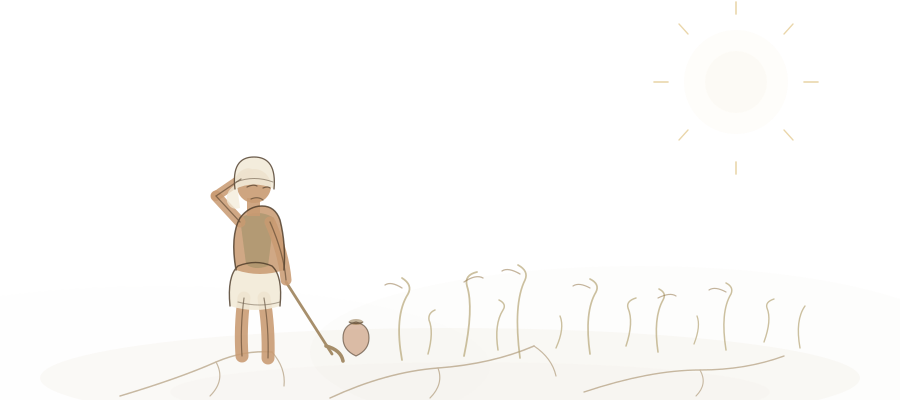
In the Tretayuga, during the time of Lord Vishwabhu Buddha, Shree Karunamaya, living in the Sukhavati Bhuvan (Western Paradise), saw the suffering beings in the country of Magadha and went to rescue them. Because there had been no rain for twenty years, the grass and trees had not grown properly, and there was nothing to eat and drink. This had driven the people to kill one another and eat each other’s flesh and drink blood to survive.
In this way, the people of Magadha were fighting among themselves. The strong killed the weak; thus, they committed great sins. Seeing this, Shree Karunamaya descended in human form, influenced them with his grace, and asked them, “O men, why do you fight and kill each other, eat the flesh and drink blood of men, commit sins, and do evil deeds like ghosts and demigods?”
Under the influence of Karunamaya’s grace, the wicked people of Magadha, who had lost sight of humanity, calmed down and paid attention to him. They gathered before Karunamaya and told him everything that had happened. “O great sage, our country of Magadha is facing great difficulties. It has not rained in this country for 20 years. Therefore, we are unable to bear the pain of not being able to eat and drink. Because of this, we have lost compassion and love and now have only anger in our hearts. So we have been killing humans. In this way, there has been turmoil for 20 years. If you have the power to pacify this famine, then please protect us all and provide us with prosperity.”
After hearing the people of Magadha’s appeal, the Miraculous Bodhisattva ascended to the sky and immediately caused clouds to gather and rain to fall. Everyone was surprised to see rain after 20 years, and they quickly drank the nectar-like water to quench their thirst. He, the Compassionate One, again made many kinds of food and sweets available to the people of Magadha. The people in the country were amazed to see rice, wheat, and other food items available, so everyone hurried to take as much food as they could home. Again, Karunamaya provided them with various gold, silver, and other metal objects. All the residents of Magadha were surprised and happily took as much as they could, safely storing it in their coffers. They collected the items with joy.
Everyone was surprised and, at the same time, happy. They gathered in their neighborhoods to discuss who had influenced the event, coming up with many arguments and theories. Then, Shree Karunamaya entered the body of an old man, went to the group of people who had gathered, and said, “O people of the country. You believe this is due to the grace of some god who has brought auspiciousness or prosperity to our country. However, no one living in heaven or hell can experience such prosperity. You should know that it is due to the grace of Shree Karunamaya Lokeshwor, the Lord of the universe. I will briefly explain his greatness. Listen carefully with one mind.”
He continued, “Shree Karunamaya is the son of the Tathagata (Buddha). He is the master of this universe, and is saving all sentient beings, showing the path of righteousness to those who do not see it. He is like an umbrella on a hot, sunny day, like a river to the thirsty, like a wish-fulfilling plant to the needy, like a doctor to the sick, and the one who saves those in hell by granting them merit to Nirvana (salvation). If you remember the name of Karunamaya and observe the Bodhicharya practice, we will all be able to hear the Dharma discourses of Amitabha Buddha in the realm of Sukhavati.” After saying this, the old man left.
From that time on, Magadha received rainfall periodically, and the canals filled with abundant water. Shree Karunamaya then left the old man’s body and went to save other beings. These are mentioned in the Gunakaranda Vyuha (a Mahayana Buddhist text).
Source: Ahtottarashata lokesvara parichaya (108 lokesvara parichaya) by Amogha Vajra Bajracharya
Disclaimer: The legend has been translated from Newari, as it is written in the book, to the best of our knowledge.
Gorakhnath and the Rain-bringing Serpents
A weave of myth, belief, and remembered history

In the old days, King Gunakamadev ruled Nepal Mandal (present-day central Nepal). Through his line and a promise made to Lord Narayan, the valley was told it could have rice and never go hungry, but only when the lord of grain, Karunamaya, was present to fill the ripening husks. Karunamaya, it was foretold, would be born in Kamuni, the land of the Yakshas (spirits), as the youngest of five hundred sons. During King Narendradev's reign, a drought fell upon the valley. The yogi Gorakhnath, defeated in a contest and annoyed by it, seized all the Naags, the bringers of rain, and sat upon them in unbroken meditation at Mrigasthali. Season after season, no rain fell, and famine spread.
When no scholar could name the cause, the king turned to the learned guru Shantikar Vajracharya. Only one thing would raise Gorakhnath, Vajracharya said: the coming of his own guru, Karunamaya Lokeshwor, whom the yogi would rise to honor, freeing the Naags.
Lokeshwor was then living in Kamuni. King Narendradev, along with a tantric priest named Bandhudatta and a porter named Rathan Chakra, set out to bring Karunamaya. On the way, they won the help of Karkotaka, king of the Naags, who bridged a petrifying river with his own body. Upon reaching Kamuni, they gained entry to the Yaksha king's palace by posing as commoners, but the Yakshani queen discovered their plan and refused to give up her son. However, Bandhudatta performed a rite that drew Karunamaya out as a bee and caught him in a golden Kalash (vessel). With four Bhairavs to carry the deity and seeds sown along the road to guide his eventual return, they journeyed back toward the valley. Along the way, Bandhudatta bound the Yakshani queen to a tree because she was trying to take Karunamaya back.
When they reached Bunga, Gorakhnath sensed his guru and rose from his meditation. The Nags were freed, and the rain returned. It was agreed that Karunamaya would share two homes, returning to Bunga after each procession, and so he does to this day. A shrine was raised in Yala, and the image of Karunamaya was made with the Kalash at its heart, from the soil where the deity's past life lay buried.
A chariot festival was founded in his honor. The chariot rises thirty-two hands for the thirty-two auspicious signs; its four wheels are the four Bhairavs, Karkotaka its main beam, and the Nags its ropes. The festival begins on Baishakh Sukla Pratipada, the first day of the bright fortnight of Baisakh. The image is carried from its shrine to the waiting chariot at Pulchowk and drawn through Gabahal, Sundhara, and Lagankhel, where the chariot circles the tree remembered as the mother of the deity. It comes at last to Jawalakhel, where the sacred bhoto (vest) is shown to the gathered valley, and the long festival closes.