The Death of St. Benedict
National Gallery of Art, Washington D.C.
1946.21.13
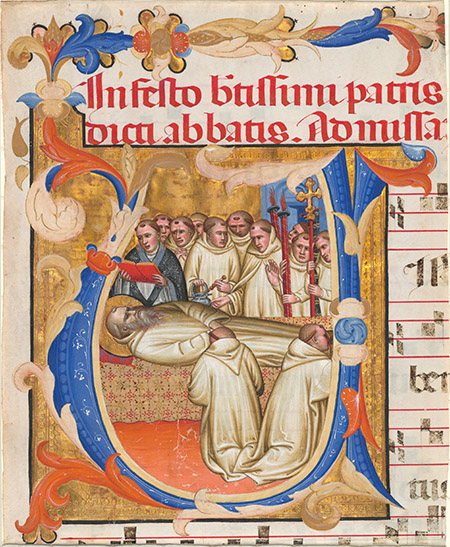 The body of St. Benedict lies across the center of a blue structure surrounded by tonsured, white clad monks. Mourning their leader, these monks exchange expressions of deep sorrow, matched by the grief they feel at his death. One monk reads aloud from a codex; a second dips a censor into a pot of liquid; two monks hold long burning candles; and one holds a crucifix. Kneeling brethren genuflect before Benedict’s hands and feet, intentionally replicating depictions of St. Francis’ death in an attempt to connect the two spiritual leaders despite the 700-year gap between them (re: Giotto’s fresco in S. Croce’s Bardi Chapel).
Bathed in gold leaf and articulated with minute punch marks along the picture’s borders and Benedict’s halo, the image adopts the elements and the scale of a small predella panel that contemporary viewers would expect to see at the base of an altarpiece. The adroit use of brown washes along the drapery folds of each monastic character suggests a level of professionalism normally seen in the work of highly skilled and carefully trained monumental painters, or dipintore, who specialized in altarpiece production.
This miniature painting came from an antiphonary, or book of chants, dedicated to ceremonies performed by monks during the spring. The Death of St. Benedict illustrates the liturgical text recited by monks on his Feast Day, observed annually on March 21, and sits within the initial V starting the word “Vir” (“man” in Latin). Extending from the black-lined boundary appear the red lines of the staff and the inked neumes that represent the notes sung by the community during this service that commemorates the virtues of the saint.
The miniature has been connected to the Olivetan community at S. Miniato due both to the depiction of monks in white cowls and the stylistic connection to a group of miniatures cut from an antiphonary similarly associated with the church (the so-called Codex Rossiano). A series of payments from the monastery to an artist (and former monk) named Don Simone Camaldolese that compensated him for painting figures in at least three antiphonaries between 1387 and 1388 confirm that the monks in S. Miniato were actively expanding their collection of liturgical manuscripts at this time.
The subject matter of the Death of St. Benedict, furthermore, matches the monumental fresco that appears on the south wall of S. Miniato’s sacristy, a space built and decorated with funds donated to the community of Olivetans there by Benedetto degli Alberti and completed in 1387. The Olivetans were a subset of the Benedictine Order, specifically under the protection of the Virgin Mary, and were involved in the practice of asceticism. The emphasis on the patron’s name-saint in this miniature also corresponds to the appearance of Benedict to the immediate left of the enthroned Madonna and Child in the altarpiece attributed to Agnolo Gaddi – which in turn was probably installed on an altar in the sacristy at the same time. Paintings in liturgical manuscripts, on altarpieces, and in mural cycles often corresponded with each other, and monastic viewers in S. Miniato’s sacristy may well have gazed on all three of these images simultaneously when they commemorated the death of their monastic founder, St. Benedict, every year on March 21.
The body of St. Benedict lies across the center of a blue structure surrounded by tonsured, white clad monks. Mourning their leader, these monks exchange expressions of deep sorrow, matched by the grief they feel at his death. One monk reads aloud from a codex; a second dips a censor into a pot of liquid; two monks hold long burning candles; and one holds a crucifix. Kneeling brethren genuflect before Benedict’s hands and feet, intentionally replicating depictions of St. Francis’ death in an attempt to connect the two spiritual leaders despite the 700-year gap between them (re: Giotto’s fresco in S. Croce’s Bardi Chapel).
Bathed in gold leaf and articulated with minute punch marks along the picture’s borders and Benedict’s halo, the image adopts the elements and the scale of a small predella panel that contemporary viewers would expect to see at the base of an altarpiece. The adroit use of brown washes along the drapery folds of each monastic character suggests a level of professionalism normally seen in the work of highly skilled and carefully trained monumental painters, or dipintore, who specialized in altarpiece production.
This miniature painting came from an antiphonary, or book of chants, dedicated to ceremonies performed by monks during the spring. The Death of St. Benedict illustrates the liturgical text recited by monks on his Feast Day, observed annually on March 21, and sits within the initial V starting the word “Vir” (“man” in Latin). Extending from the black-lined boundary appear the red lines of the staff and the inked neumes that represent the notes sung by the community during this service that commemorates the virtues of the saint.
The miniature has been connected to the Olivetan community at S. Miniato due both to the depiction of monks in white cowls and the stylistic connection to a group of miniatures cut from an antiphonary similarly associated with the church (the so-called Codex Rossiano). A series of payments from the monastery to an artist (and former monk) named Don Simone Camaldolese that compensated him for painting figures in at least three antiphonaries between 1387 and 1388 confirm that the monks in S. Miniato were actively expanding their collection of liturgical manuscripts at this time.
The subject matter of the Death of St. Benedict, furthermore, matches the monumental fresco that appears on the south wall of S. Miniato’s sacristy, a space built and decorated with funds donated to the community of Olivetans there by Benedetto degli Alberti and completed in 1387. The Olivetans were a subset of the Benedictine Order, specifically under the protection of the Virgin Mary, and were involved in the practice of asceticism. The emphasis on the patron’s name-saint in this miniature also corresponds to the appearance of Benedict to the immediate left of the enthroned Madonna and Child in the altarpiece attributed to Agnolo Gaddi – which in turn was probably installed on an altar in the sacristy at the same time. Paintings in liturgical manuscripts, on altarpieces, and in mural cycles often corresponded with each other, and monastic viewers in S. Miniato’s sacristy may well have gazed on all three of these images simultaneously when they commemorated the death of their monastic founder, St. Benedict, every year on March 21.
 The body of St. Benedict lies across the center of a blue structure surrounded by tonsured, white clad monks. Mourning their leader, these monks exchange expressions of deep sorrow, matched by the grief they feel at his death. One monk reads aloud from a codex; a second dips a censor into a pot of liquid; two monks hold long burning candles; and one holds a crucifix. Kneeling brethren genuflect before Benedict’s hands and feet, intentionally replicating depictions of St. Francis’ death in an attempt to connect the two spiritual leaders despite the 700-year gap between them (re: Giotto’s fresco in S. Croce’s Bardi Chapel).
Bathed in gold leaf and articulated with minute punch marks along the picture’s borders and Benedict’s halo, the image adopts the elements and the scale of a small predella panel that contemporary viewers would expect to see at the base of an altarpiece. The adroit use of brown washes along the drapery folds of each monastic character suggests a level of professionalism normally seen in the work of highly skilled and carefully trained monumental painters, or dipintore, who specialized in altarpiece production.
This miniature painting came from an antiphonary, or book of chants, dedicated to ceremonies performed by monks during the spring. The Death of St. Benedict illustrates the liturgical text recited by monks on his Feast Day, observed annually on March 21, and sits within the initial V starting the word “Vir” (“man” in Latin). Extending from the black-lined boundary appear the red lines of the staff and the inked neumes that represent the notes sung by the community during this service that commemorates the virtues of the saint.
The miniature has been connected to the Olivetan community at S. Miniato due both to the depiction of monks in white cowls and the stylistic connection to a group of miniatures cut from an antiphonary similarly associated with the church (the so-called Codex Rossiano). A series of payments from the monastery to an artist (and former monk) named Don Simone Camaldolese that compensated him for painting figures in at least three antiphonaries between 1387 and 1388 confirm that the monks in S. Miniato were actively expanding their collection of liturgical manuscripts at this time.
The subject matter of the Death of St. Benedict, furthermore, matches the monumental fresco that appears on the south wall of S. Miniato’s sacristy, a space built and decorated with funds donated to the community of Olivetans there by Benedetto degli Alberti and completed in 1387. The Olivetans were a subset of the Benedictine Order, specifically under the protection of the Virgin Mary, and were involved in the practice of asceticism. The emphasis on the patron’s name-saint in this miniature also corresponds to the appearance of Benedict to the immediate left of the enthroned Madonna and Child in the altarpiece attributed to Agnolo Gaddi – which in turn was probably installed on an altar in the sacristy at the same time. Paintings in liturgical manuscripts, on altarpieces, and in mural cycles often corresponded with each other, and monastic viewers in S. Miniato’s sacristy may well have gazed on all three of these images simultaneously when they commemorated the death of their monastic founder, St. Benedict, every year on March 21.
The body of St. Benedict lies across the center of a blue structure surrounded by tonsured, white clad monks. Mourning their leader, these monks exchange expressions of deep sorrow, matched by the grief they feel at his death. One monk reads aloud from a codex; a second dips a censor into a pot of liquid; two monks hold long burning candles; and one holds a crucifix. Kneeling brethren genuflect before Benedict’s hands and feet, intentionally replicating depictions of St. Francis’ death in an attempt to connect the two spiritual leaders despite the 700-year gap between them (re: Giotto’s fresco in S. Croce’s Bardi Chapel).
Bathed in gold leaf and articulated with minute punch marks along the picture’s borders and Benedict’s halo, the image adopts the elements and the scale of a small predella panel that contemporary viewers would expect to see at the base of an altarpiece. The adroit use of brown washes along the drapery folds of each monastic character suggests a level of professionalism normally seen in the work of highly skilled and carefully trained monumental painters, or dipintore, who specialized in altarpiece production.
This miniature painting came from an antiphonary, or book of chants, dedicated to ceremonies performed by monks during the spring. The Death of St. Benedict illustrates the liturgical text recited by monks on his Feast Day, observed annually on March 21, and sits within the initial V starting the word “Vir” (“man” in Latin). Extending from the black-lined boundary appear the red lines of the staff and the inked neumes that represent the notes sung by the community during this service that commemorates the virtues of the saint.
The miniature has been connected to the Olivetan community at S. Miniato due both to the depiction of monks in white cowls and the stylistic connection to a group of miniatures cut from an antiphonary similarly associated with the church (the so-called Codex Rossiano). A series of payments from the monastery to an artist (and former monk) named Don Simone Camaldolese that compensated him for painting figures in at least three antiphonaries between 1387 and 1388 confirm that the monks in S. Miniato were actively expanding their collection of liturgical manuscripts at this time.
The subject matter of the Death of St. Benedict, furthermore, matches the monumental fresco that appears on the south wall of S. Miniato’s sacristy, a space built and decorated with funds donated to the community of Olivetans there by Benedetto degli Alberti and completed in 1387. The Olivetans were a subset of the Benedictine Order, specifically under the protection of the Virgin Mary, and were involved in the practice of asceticism. The emphasis on the patron’s name-saint in this miniature also corresponds to the appearance of Benedict to the immediate left of the enthroned Madonna and Child in the altarpiece attributed to Agnolo Gaddi – which in turn was probably installed on an altar in the sacristy at the same time. Paintings in liturgical manuscripts, on altarpieces, and in mural cycles often corresponded with each other, and monastic viewers in S. Miniato’s sacristy may well have gazed on all three of these images simultaneously when they commemorated the death of their monastic founder, St. Benedict, every year on March 21.